The Gambler’s Fallacy Explained
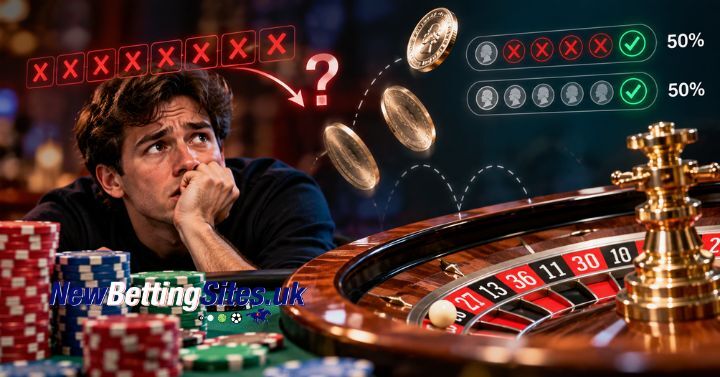
The gambler’s fallacy is the mistaken belief that a run of past results changes the probability of the next result when the events are actually independent.
The classic example is a fair coin. If it lands on heads five times in succession, it can feel as though tails must now be more likely. It is not. Assuming the coin and toss are fair, the next flip still has a 50% chance of heads and a 50% chance of tails.
The same mistake can influence decisions involving roulette, lotteries and other forms of gambling and betting. It can also appear when someone thinks a losing streak means their next bet is somehow "due" to win.
What is the gambler’s fallacy?
The gambler’s fallacy occurs when independent random events are treated as though earlier outcomes create pressure for later outcomes to compensate.
Typical examples include thinking:
- "Red has appeared five times, so black must be due."
- "I have lost six bets in a row, so the next one is more likely to win."
- "This lottery number has not appeared for months, so it must come up soon."
- "There have been several heads in succession, so another head is now unlikely."
In each case, the conclusion is wrong if the next event is genuinely independent and its underlying probability has not changed.
A useful way to remember the principle is that a fair coin, roulette wheel or random draw does not keep a record of what it "owes" you.
A simple coin-toss example
Suppose a fair coin lands on heads five times in a row:
H – H – H – H – H
What is the probability of tails on the sixth toss?
50%.
The first five results do not alter the physical coin or the probability attached to the sixth toss.
This can feel surprising because getting six heads in a row from the beginning is quite unlikely:
(1/2)6 = 1/64 = 1.5625%
But that answers a different question. It is the probability of predicting the entire six-head sequence before any of the tosses take place.
Once five heads have already happened, those outcomes are known. There is only one uncertain toss left, and its probability of heads remains 1/2.
The probability of a sequence is not the probability of the next event
This distinction is at the heart of the gambler’s fallacy.
Before ten fair coin tosses begin, the probability of getting ten heads in succession is:
(1/2)10 = 1/1,024
That is unusual. However, if you have already watched nine consecutive heads, the chance that the tenth toss will also be heads is still 50%.
There is nothing contradictory about those statements. One describes the probability of an entire sequence before it begins; the other describes one independent event after the previous outcomes are already known.
The Monte Carlo fallacy
The gambler’s fallacy is also known as the Monte Carlo fallacy, after a famous roulette episode reported at the Casino de Monte-Carlo in Monaco on 18 August 1913.
Black is widely recorded as having appeared 26 times in succession. As the run continued, gamblers reportedly placed increasingly large bets on red because they believed the sequence had to reverse.
It did not have to reverse. Every new spin was a separate event.
The probability of one specific run of 26 consecutive blacks on a European single-zero roulette wheel is approximately:
(18/37)26 ≈ 1 in 136.8 million
That makes the complete sequence extremely unusual when considered before it happens. But after 26 blacks have already occurred, those 26 results do not reduce the probability of black on spin 27.
Roulette is not exactly 50/50
The old version of this example is sometimes simplified by saying that red and black each have a 50% probability. That is not quite correct for a standard European roulette wheel.
There are 37 pockets:
| Outcome | Pockets | Probability |
|---|---|---|
| Red | 18 | 18/37, or about 48.65% |
| Black | 18 | 18/37, or about 48.65% |
| Green zero | 1 | 1/37, or about 2.70% |
So after a long sequence of blacks, red is not suddenly more likely than black. On an unbiased European wheel, both remain 18/37 on the next spin.
The green zero is also why an even-money red or black roulette bet does not have a true 50% winning probability.
What the law of large numbers actually means
The gambler’s fallacy is often caused by misunderstanding the law of large numbers.
Over a very large number of independent trials, the proportion of outcomes tends to move closer to the underlying probability. With a fair coin, for example, the percentage of heads tends towards 50% as the number of tosses becomes very large.
But this does not mean the coin actively compensates for previous results.
If you begin with ten heads in a row, probability does not require ten extra tails to arrive shortly afterwards. Future tosses can simply continue to occur approximately 50/50. As thousands of additional results accumulate, the original run of ten heads becomes a smaller and smaller proportion of the total.
In other words, long-run proportions can move towards their expected values through dilution, not because future outcomes are forced to correct the past.
This distinction is explained in Cambridge University Press's discussion of the law of large numbers and the gambler’s fallacy.
Why streaks seem more meaningful than they are
Human beings are good at noticing patterns, but genuinely random sequences often look less orderly than we expect.
People may imagine that a random sequence should regularly alternate:
H – T – H – T – T – H – T – H
A sequence such as:
H – H – H – H – T – T – H – H
can therefore feel suspicious or as though a reversal is overdue.
In reality, clusters and streaks are a normal feature of randomness. A fair process does not have to alternate neatly to remain fair.
Research on decision-making has repeatedly found gambler’s-fallacy behaviour in random sequences. A study published in Judgment and Decision Making, for example, describes the fallacy as incorrectly expecting negative correlation in a sequence whose outcomes are actually uncorrelated.
How the gambler’s fallacy affects betting
The mistake becomes particularly relevant when a bettor starts treating their own sequence of wins and losses as evidence about what should happen next.
Suppose you lose five football bets in succession. That does not make the sixth selection more likely to win simply because five previous wagers lost.
Each new bet still needs to be assessed on its own:
- What outcome are you betting on?
- What probability do you assign to it?
- What odds are available?
- Does the price represent value?
Your previous betting results do not improve the underlying probability of the next selection.
This is one reason the gambler’s fallacy can contribute to chasing losses. Someone may believe that after several defeats a winner is due, increase their stake and expose more money to another uncertain result.
Experimental research has also found increased betting following losing streaks, which researchers have linked with loss-chasing behaviour.
The gambler’s fallacy does not apply to every sequence
The key word is independent.
Past events genuinely can change the probability of future events when the events are dependent.
Consider drawing cards from a standard deck without replacement. If you draw an ace and do not put it back, there are now fewer aces remaining. The first result has physically changed the composition of the deck, so the probability of drawing another ace has changed.
That is completely different from repeatedly tossing the same fair coin, where one toss does not alter the next.
| Example | Are successive outcomes independent? | Can earlier results change the next probability? |
|---|---|---|
| Fair coin tosses | Yes | No |
| Unbiased roulette spins | Yes | No |
| Fair dice rolls | Yes | No |
| Cards drawn without replacement | No | Yes |
What about winning and losing streaks in sport?
Sport requires more care because results are not generated in the same way as coin tosses or roulette spins.
If a football team has lost five consecutive matches, it would be wrong to say that it is more likely to win the sixth simply because a win is due. That would be gambler’s-fallacy reasoning.
However, the previous matches may contain genuine information about the next one. Injuries, changes in tactics, the quality of opposition, player performance and other factors can affect future probabilities.
So a streak in sport should neither be automatically reversed nor automatically continued. You need to investigate the underlying causes.
The same distinction applies to betting records. Losing your last five bets does not itself make the sixth more likely to win. If there is relevant new information about the event you are betting on, that information should be analysed separately from your personal streak.
Gambler’s fallacy vs the hot-hand belief
The opposite intuition can also occur. Instead of expecting a streak to reverse, someone may believe it will continue because an outcome is "hot".
For example:
- Gambler’s fallacy: black has appeared repeatedly, therefore red is due.
- Hot-outcome belief: black has appeared repeatedly, therefore black is more likely to appear again.
When the underlying events are independent, neither conclusion follows from the streak alone.
A related idea is the hot-hand belief, where a person is thought to be more likely to succeed because they have recently been successful. Academic research distinguishes this from simply believing that a particular random outcome is "hot".
What is the inverse gambler’s fallacy?
The term inverse gambler’s fallacy has a more specific meaning and should not simply be used as another name for believing that a streak will continue.
It describes reasoning from an unusually remarkable outcome to the assumption that there must have been many previous trials. In other words, observing something improbable is taken as evidence that there were probably numerous opportunities for it to occur.
That is a different error from seeing several blacks on a roulette wheel and deciding that black is now more likely to appear again.
How to avoid the gambler’s fallacy
A few questions can help expose the mistake:
- Are the events genuinely independent? If one result cannot alter the next event's probability, a streak alone should not change your forecast.
- Am I saying something is "due"? Words such as "due", "overdue" and "has to turn eventually" are warning signs when applied to independent outcomes.
- Am I confusing a whole sequence with the next event? A long streak can be unlikely before it begins without making its next continuation less likely once the streak already exists.
- Has the underlying probability actually changed? Look for real evidence rather than assuming that chance is trying to restore balance.
- Am I changing my stake because of previous losses? Losing earlier bets does not make a future wager safer.
The key lesson
The gambler’s fallacy is ultimately a misunderstanding of independence.
A long run of heads does not make tails due. A string of black roulette results does not increase the probability of red on the next unbiased spin. A sequence of losing bets does not create a better chance of winning the next one.
Long-run results may move towards their expected proportions, but they do not do so because chance remembers the past and deliberately corrects an imbalance.
When assessing any apparent streak, ask one question first: has anything happened that genuinely changes the probability of the next event? If the answer is no, the streak itself is not a reason to expect either a reversal or a continuation.
Online gambling in Great Britain is restricted to people aged 18 or over. Previous losses are never a reason to increase your stake or continue betting in an attempt to recover money.
Best 10 New Bookmakers
 |
£30 | SIGN UP HERE |
|
18+. New Players Only. Min deposit £20. Offer is a £30 free bet when you bet £10 in one single transaction, on any sports at odds of 2.00 or higher. Free bet credited upon qualifying bet settlement. Free Bet can be redeemed on any sports market and used in one single transaction. Winnings credited as cash and immediately withdrawable. Free bet expires 7 days after being credited. Free Bets non withdrawable. Free Bet stakes not included in returns. Affordability checks apply. Terms apply. Please gamble responsibly. GambleAware.org. |
||
 |
£30 | SIGN UP HERE |
|
18+ New customers only. Place a £10+ bet at min odds 1/1 (2.0) within 14 days of sign-up. Get £30 in Free Bets, valid for 7 days on selected bets only. Free stake not returned with winnings. T&Cs apply. BeGambleAware.org |
||
 |
£20 | SIGN UP HERE |
|
New verified customers only. Opt-in required. Deposit £20 and earn £1 of Free Bet value for every £1 staked on Bet Builders, with each qualifying stake counting towards a free bet builder reward, at combined odds of 2.0 (1/1) or greater. Min Reward: £1 Free Bet / Max Reward: £20 Free Bet. Cash in or claim within 48 hours of promo end. Free Bets expire 7 days after claim. 18+ GambleAware.org |
||
 |
£25 | SIGN UP HERE |
|
New customers only. Bets placed on sports at odds of 2.50 or more to qualify. Bets must be placed 25 hours within registration. £25 free bets must be wagered on sports. Full terms below. Gambling can be addictive, play responsibly 18+ |
||
 |
£10 | SIGN UP HERE |
|
18+. New GB customers referred by selected marketing partners only. Activate the sports welcome offer on your first deposit and opt in to sports bonuses and marketing. Deposit £10+ and place a £10+ sports bet at odds of 2.00+. £10 Free Bet credited after the qualifying bet settles. Use within 24 hours at odds of 2.00+. Free bet stake not returned. Voided, cashed-out or partially cashed-out bets do not qualify. Cash funds are used before free bets. Cannot be combined with the casino welcome offer. Full T&Cs apply. Please gamble responsibly. |
||
 |
£20 | SIGN UP HERE |
|
New online customers only. Register and place a £/€5+ first bet at 1/1 (2.0)+ on sports or racing within 7 days. Get a £/€10 Tote Credit and £/€10 Free Sports Bet within 48 hours of settlement. Voided/non-runner bets don’t qualify. Rewards expire in 7 days. 18+. One per customer. Selected customers only. Full T&Cs apply. GambleAware.org. |
||
 |
£30 | SIGN UP HERE |
|
*New members only. £10+ bet on sportsbook (ex. virtuals) at 1.5 min odds, settled within 14 days. Free Bets: accept in 7 days, valid 7 days on sportsbook only. 2x£5 Free Bets for Bet Builder only. Stake not returned. T&Cs + deposit exclusions apply. Bet Responsibly. GambleAware®. 18+ |
||
 |
£30 | SIGN UP HERE |
|
New customers place your first bet of £10 at minimum odds of 1/1 on any sports market within 7 days of registering. Get £20 in ACCA Free Bets (2x£10 Acca Free bet (2+ selections, pre-match or in-play/live, min odds per leg 2/5 (1.4), max payout £50) . Full terms apply. 18+ begambleaware. Please gamble responsibly. |
||
 |
£30 | SIGN UP HERE |
|
18+ New customers only. Opt in and bet up to £40 (min. £20) via mobile or app on any football (odds 1/1+) within 7 days of registration. Get up to £40 in free bets on selected markets, which expire in 7 days. T&Cs apply. GambleAware.org | Please gamble responsibly |
||
 |
£100 | SIGN UP HERE |
|
*New UK/IE customers . Place your first Football bet as an Accumulator (minimum four selections) and AK Bets will boost the return by 25% in the form of a Free Bet up to a value of £100. 18+ BeGambleAware.org." |
||